 Pearl Harbor Tours from Honolulu
Iolani Palace: History, Tours and Tickets for the Only Royal Palace on US Soil
Iolani Palace in downtown Honolulu is the only royal palace on US soil, built for King Kalakaua and finished in 1882. This guide covers its history, the overthrow of the Hawaiian monarchy, the docent and audio tours, and what a ticket costs. It also explains the palace's neighbours, the King Kamehameha statue, Aliiolani Hale and the Hawaii State Capitol. If you want Pearl Harbor itself, see Pearl Harbor tours from Honolulu, which compares the half-day Arizona and city tours and the full-day options. Some of those city routes pass the palace, and this page says plainly which ones stop and which only drive past.
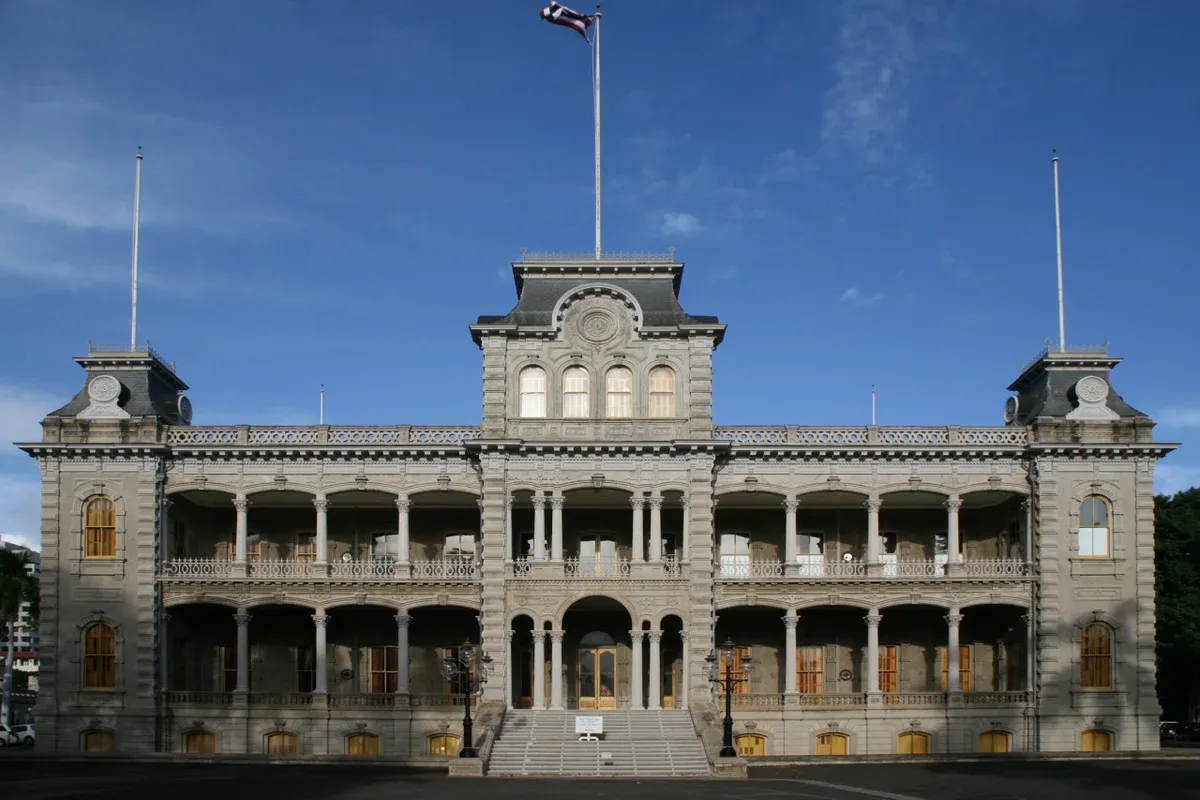
The front of Iolani Palace in Honolulu. Photo: Cliff from Arlington, Virginia, USA, CC BY 2.0, via Wikimedia Commons
Quick answer Iolani Palace at a glance
Admission to Iolani Palace costs $34 for the docent-led tour and $28 for the self-led audio tour, with cheaper rates for teens and youth. The palace in downtown Honolulu was completed in 1882, served the Hawaiian monarchy until the 1893 overthrow, and opened as a museum in 1978. Tickets are sold online only, and tours run Tuesday through Saturday.
Key takeaways
- The docent tour is $34 for adults, $31 for teens and $16 for youth 5 to 12. See the ticket and tour details.
- No tour in the Pearl Harbor and Honolulu City Tour family includes entry. City tours drive past or stop at the grounds only, and the Small-Group Arizona Memorial Tour visits the palace grounds without going inside.
- The building served as the capitol of Hawaii until 1969, when the Hawaii State Capitol opened nearby.
- Want to compare it with the harbour itself? The USS Arizona Memorial guide covers the reservation and the boat program.
The Palace and the Monarchy
Iolani Palace is the centrepiece of the Hawaii Capital Historic District and the key to understanding how the kingdom of Hawaii ended. Its timeline is short but crowded with events.
How the Palace Came to Be
The building you see today is the second royal residence on the site. An earlier palace called Hale Alii was built by Mataio Kekuanaoa, Royal Governor of Oahu, for his daughter Princess Victoria Kamamalu, and the site served the monarchy from Kamehameha III in 1845. By the time Kalakaua took the throne the old building had suffered ground termite damage. Kalakaua, the first monarch to travel around the world, wanted a palace like Europe's.
The cornerstone of the new palace was laid on December 31, 1879 with Masonic rites. Construction finished in 1882 at a cost of over $340,000. The palace was built of brick with concrete facing, and a coronation ceremony for Kalakaua was held on February 12, 1883, though he had already reigned for nine years.
The table below sets out the dates from the palace's own history page and standard references. Kamehameha I's first royal residence was actually the Brick Palace at Lahaina on Maui, so the Honolulu building is not the first royal house in the islands, but it is the only one still standing as a palace on US soil.
| Year | What happened |
|---|---|
| 1845 | The site becomes the royal residence beginning with Kamehameha III |
| 1879 | The cornerstone of the new palace is laid on December 31 with Masonic rites |
| 1882 | Construction finishes in November at a cost of over $340,000 |
| 1883 | Kalakaua's coronation ceremony is held on February 12 |
| 1891 | Queen Liliuokalani succeeds her brother Kalakaua after his death on January 20 |
| 1893 | The monarchy ends, ending the palace's role as a royal residence |
| 1895 | Queen Liliuokalani is imprisoned for nine months in a small room upstairs after the rebellion |
| 1962 | The palace is designated a National Historic Landmark on December 29 |
| 1969 | It stops serving as the capitol when the new State Capitol opens |
| 1978 | It opens as a museum |
The Building and the Overthrow
Kalakaua's palace was built of brick with concrete facing. Many original furnishings were sold at public auction after the overthrow, and personal belongings were returned to the royal family. The palace's own historians describe it today as a living restoration of Hawaiian national identity.
The overthrow did not happen inside these walls. From Aliiolani Hale, the judiciary building across the street, the Committee of Safety proclaimed the provisional government in 1893. Queen Liliuokalani's hardest months here came later. After the 1895 rebellion she was imprisoned for nine months in a small room upstairs.
After the monarchy the palace simply changed jobs. It served as the capitol of Hawaii for almost 80 years, housing the territorial and then state government, before being vacated and restored in the 1970s. It reopened as a museum in 1978 and remains a registered National Historic Landmark.
King Kalakaua and Queen Liliuokalani
Kalakaua died on January 20, 1891. He was the first monarch in the world to travel around the entire globe, and he wanted a palace like Europe's. His coronation came nine years into his reign, on February 12, 1883.
His sister Liliuokalani succeeded him and reigned until the overthrow in 1893. She is the monarch most present at the palace today. A statue of her stands between the palace and the State Capitol, dedicated April 10, 1982.
Where the Palace Stands
The palace sits at the corner of King Street and Richards Street in downtown Honolulu, inside the Hawaii Capital Historic District. Chinatown lies a few blocks west. The palace describes itself as a short drive or bus ride from Waikiki, which is fair for a city location.
You can combine it with the harbour in one day if you plan the timing, since Pearl Harbor tour from Waikiki options that include a city drive list the palace on their route.
Sources: Pearl Harbor National Memorial, National Park Service, Recreation.gov, Pearl Harbor Historic Sites
Visiting the Palace
You buy tickets online and you cannot walk up. Once you know that rule and the two tour formats, the visit itself is simple.
Docent Tour and Audio Tour Prices
There are two ways inside. The docent-led tour costs $34 for adults, $31 for teens and $16 for youth 5 to 12, and children aged 0 to 4 are free. Hawaii residents with proof of residency pay a kamaaina rate of $19.95 for the docent tour. The self-led audio tour costs $28 for adults, $23 for teens and $13 for youth. No tour sold on this site includes palace entry, so these are the only prices that get you through the door.
Children under 5 enter free on both tours but must be carried, seated in a Palace stroller or holding an adult's hand. Tours are offered Tuesday through Saturday. The palace itself says reservations are highly recommended, and because sales are online only with no walk-ups and no same-day reservations, book ahead by as many days as your trip allows.
| Tour | Adult | Days | Length |
|---|---|---|---|
| Docent-led tour | $34 ($19.95 kamaaina) | Tuesday through Saturday | not stated |
| Self-led audio tour | $28 | Tuesday through Saturday | not stated |
Booking Rules and What to Wear
Ticket sales are online only. The palace accepts no walk-ups and no same-day reservations, so a spontaneous add-on to a downtown stroll is not possible. Pick your tour and time slot before you leave your hotel.
The dress code matters more here than at most Honolulu sights. Shirts and footwear are required and the palace gives you shoe coverings to protect the floors. Beachwear is not permitted, so swimmers need a change of clothes. Tripods, monopods and selfie sticks are all banned inside. Leave the tripod at the hotel.
Can a Pearl Harbor Tour Take You Inside?
No tour in the catalog on the Honolulu Pearl Harbor tours includes entry to the palace, because none sells a palace ticket. Be clear about what each one does. The Pearl Harbor and Honolulu City Tour from Roberts Hawaii at $69 passes Iolani Palace and Kawaiahao Church and lists the King Kamehameha statue and the State Capitol among its sights.
The Pearl Harbor and Punchbowl Tour from Polynesian Adventure at $58 also lists the palace as a drive-by. The Small-Group Arizona Memorial Tour at $100 does slightly better, stopping at the palace grounds with the King Kamehameha statue, but it does not go inside. To enter the building you buy the palace's own $34 or $28 ticket online and visit on your own.
The Palace's Neighbours
Three buildings around the palace fill out a downtown hour. Across King Street stands Aliiolani Hale, which means House of Heavenly Kings. Designed by Australian Thomas Rowe in Italian Renaissance Revival style and dedicated in 1874 by King Kalakaua, it was ordered as a government office building even though it was designed as a palace. It now houses the Hawaii State Supreme Court and the King Kamehameha V Judiciary History Center with a restored historic courtroom. A time capsule buried by Kamehameha V at the cornerstone was located with ground-penetrating radar in December 2005.
In front of Aliiolani Hale stands the King Kamehameha statue, 18 feet of bronze by Thomas Gould made in Florence. The Honolulu statue was dedicated in 1883 and is the second casting. The original was recovered and erected at Kamehameha's birthplace in Kohala, dedicated May 8, 1883. On the Friday closest to June 11, Kamehameha Day, the statue is draped with flower lei.
Close to the palace is the Hawaii State Capitol, which opened March 15, 1969 and replaced the palace as the statehouse. Its two legislative chambers are cone-shaped to symbolise volcanoes, it is surrounded by a reflecting pool symbolising the Pacific Ocean, and the open-air design leaves a central atrium open to the sky. Entrances are open Monday through Friday 7am to 5pm. Guided tours are no longer offered, but a self-guided brochure is available in Room 415. The Legislature meets here with a 25-member Senate and a 51-member House.
Iolani Palace: The Only Royal Palace in the United States
The rooms of the palace and the story of the last Hawaiian monarchs. Third-party video by This House. This site did not shoot it and has no relationship with the creator.
Around the Palace
The palace sits in the Hawaii Capital Historic District, a few blocks of civic buildings and churches that reward an hour of walking. Each neighbour has its own story and its own figure worth knowing.
The King Kamehameha Statue
Across King Street from the palace, in front of Aliʻiōlani Hale, stands the 18-foot bronze statue of Kamehameha I. Thomas Gould made it in Florence, and the figure in Honolulu is the second casting. It was dedicated in 1883. On the Friday closest to June 11, Kamehameha Day, the statue is draped with long strands of flower lei. The first casting ended up at Kamehameha's birthplace in Kohala on the Big Island, where it was dedicated on May 8, 1883, after the original was recovered.
The statue is the easiest photo stop downtown and the Small-Group Arizona Memorial Tour lists the statue as a stop. It is at street level, so you can see it any time without a ticket.
Aliʻiōlani Hale
The name means House of Heavenly Kings. Thomas Rowe, an Australian architect, designed it in Italian Renaissance Revival style, and it was ordered as a government office building even though it was drawn up as a palace. Kamehameha V laid the cornerstone on February 19, 1872, and King Kalākaua dedicated the finished building in 1874. It now houses the Hawaiʻi State Supreme Court and the King Kamehameha V Judiciary History Center, which keeps a restored historic courtroom.
The building also carries the weight of 1893. It was from Aliʻiōlani Hale that the Committee of Safety proclaimed the provisional government after the overthrow of the queen. A time capsule buried by Kamehameha V under the cornerstone was located with ground-penetrating radar in December 2005.
The Hawaii State Capitol
The state Capitol replaced the palace as Hawaii's statehouse and opened on March 15, 1969. It stands close to the palace. The building is worth a look for its symbolism alone: the two legislative chambers are cone-shaped to represent volcanoes, a reflecting pool around the base stands for the Pacific Ocean, and the open-air atrium is open to the sky. Sets of eight items recur through the design for the eight main islands, and four kukui nut trees reference the four counties and four major Hawaiian gods.
The Capitol is open to the public Monday to Friday, 7am to 5pm. Guided tours are no longer offered, but a self-guided brochure is available in Room 415. The Vietnam War memorial on the grounds holds 768 black marble pedestals engraved with the names of 312 service members. A statue of Queen Liliʻuokalani between the Capitol and the palace was dedicated on April 10, 1982.
Kawaiahaʻo Church
A short walk west on King Street stands Kawaiahaʻo Church, the oldest church on Oʻahu. The congregation was established in 1820 under Kuhina Nui Kaʻahumanu, and the Great Stone Church was built between 1836 and 1842 from about 14,000 coral slabs. Hawaiian divers chiseled each block by hand from reef 3 to 6 meters underwater. The name means the water of Haʻo, after a spring and pool belonging to High Chiefess Haʻo.
Kawaiahaʻo and the nearby Mission Houses were jointly designated a National Historic Landmark in 1962. The church still uses the Hawaiian language for parts of its services and streams a Sunday morning worship service online at 9:30am. The Mission Houses at 553 S. King Street include the Oldest Frame House, whose pre-cut timber arrived by ship around Cape Horn from Boston in 1821, and the coral Chamberlain House built in 1831.
A Word on Pearl Harbor
Downtown is history on land. For the harbor itself, the Pearl Harbor tours from Honolulu compared on this site run from Waikiki daily, and the USS Arizona Memorial guide explains how the reservations work.
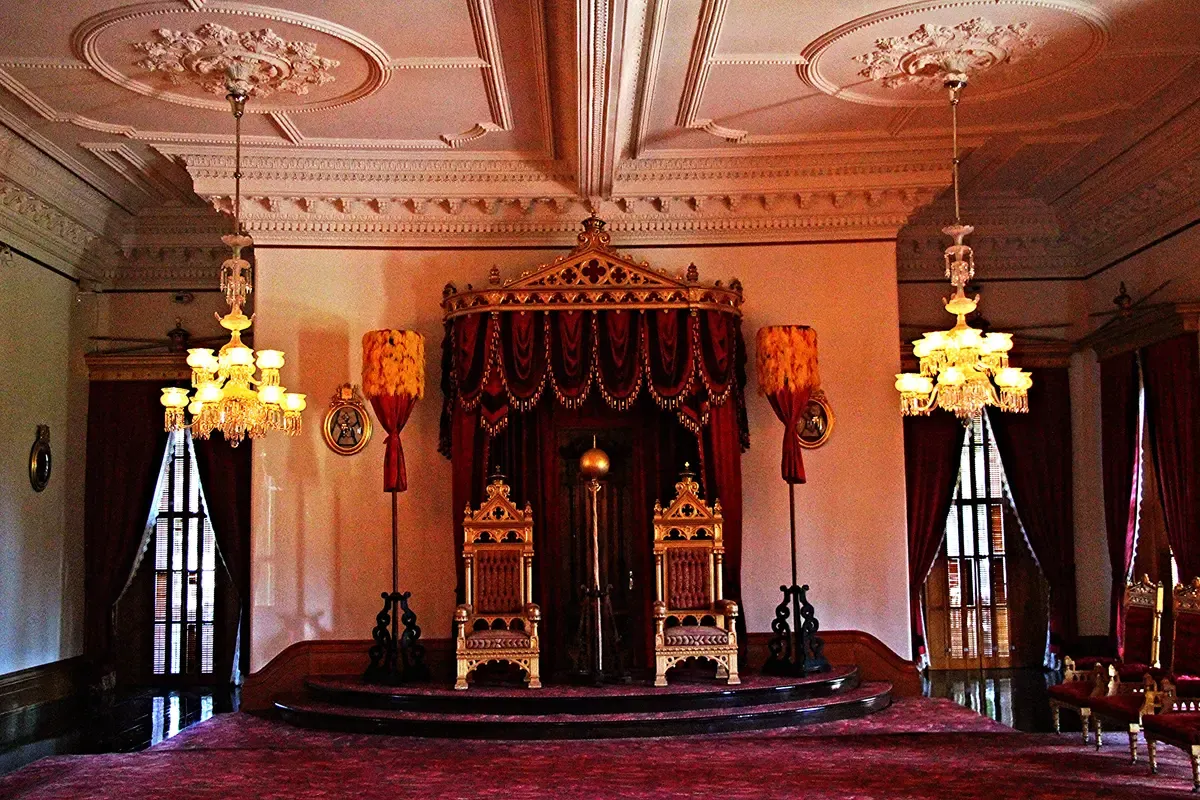
The Throne Room inside Iolani Palace. Photo: Jason Raia from Valley Forge, PA, USA, CC BY 2.0, via Wikimedia Commons
Pairing the Palace with Pearl Harbor
If you want both Pearl Harbor and the palace in one day, a guided tour saves the driving and the parking. The figures below come from the tour listings themselves, and the last column tells you honestly what happens at the palace, because none of these tours go inside. Only the palace's own docent and audio tours enter the building.
Tours That Include Iolani Palace
Several tours in the catalog list Iolani Palace among their sites, and none of them sells palace entry. Two drive past, one lists the grounds, and the private tour lists the palace as a stop on its route. For an interior visit you still book the palace's own tour separately, online only, at the prices in the visiting section above.
| Tour | Price | Hours | At the palace |
|---|---|---|---|
| Roberts Hawaii Pearl Harbor and Honolulu City Tour | $69 | 5 hours | Pass by |
| Polynesian Adventure Pearl Harbor and Punchbowl Tour | $58 | 6 hours | Drive-by |
| Small-Group Arizona Memorial Tour | $100 | 4 hours | Palace grounds |
| Private Pearl Harbor and Honolulu City Tour | $233 | 4 to 5 hours | Stop |
Tips for Visiting
Do
- Do book online in advance because the palace sells tickets online only, with no walk-ups or same-day reservations.
- Do pick a Tuesday to Saturday date because that is when palace tours are offered, and reservations are highly recommended.
- Do wear a shirt and proper footwear because the palace requires both and provides shoe coverings for the floors.
- Do carry children under 5, in your arms, in a Palace stroller or holding a hand, because they enter free but are not allowed to roam.
- Do plan extra time for the neighbours because the Kamehameha statue, Aliʻiōlani Hale and the Capitol all stand close to the palace.
Don't
- Don't arrive in beachwear because the palace does not permit it, and this is a formal historic building.
- Don't bring a tripod, monopod or selfie stick because the palace bans all three.
- Don't count on a city tour to take you inside because the tours that list the palace only pass by, drive by or stop at the grounds.
- Don't confuse the palace with the statehouse because the Capitol on Beretania Street replaced it in 1969 and is a separate building with its own hours, Monday to Friday 7am to 5pm.
Frequently Asked Questions
How much does it cost to get into Iolani Palace?
The docent-led tour costs $34 for adults, $31 for teens and $16 for youth aged 5 to 12, with children aged 0 to 4 free. The self-led audio tour costs $28 for adults, $23 for teens and $13 for youth. Kamaʻāina adults pay $19.95 on the docent tour. Details are in the visiting section of this Iolani Palace guide.
Can I wear shorts to Iolani Palace?
The palace requires shirts and footwear and does not permit beachwear, so wear a shirt and shoes. Shoe coverings are provided. The Palace and its neighbours sit in a working government district, so dress as you would for any indoor museum.
What happened to the Hawaiian royal palace?
After the monarchy ended, the building served as the capitol until 1969, when the new state Capitol opened. It was restored in the 1970s and opened as a museum in 1978. Queen Liliʻuokalani had been imprisoned for nine months in a small room upstairs after the 1895 rebellion. The full story is in the history of the palace.
Do any Pearl Harbor tours go inside Iolani Palace?
No. The tours that list the palace only pass it, drive by it or stop at the grounds, and none of them includes palace entry. To see the interior you book the palace's own docent or audio tour directly from the palace. The comparison in Pairing the Palace with Pearl Harbor shows exactly which tours come closest.
Where is Iolani Palace and how do I get there?
The palace stands at the corner of King Street and Richards Street in downtown Honolulu, which the palace describes as a short drive or bus ride from Waikiki. It shares the block with the King Kamehameha statue and Aliʻiōlani Hale, described in Around the Palace. Parking at the nearby state Capitol is in the basement, entered via Miller Street.
Is the palace part of Pearl Harbor?
It is not. Iolani Palace is a separate museum in downtown Honolulu, in a different part of Oahu from the Pearl Harbor Visitor Center. If you want to see both, either book a city tour that includes the palace route, such as the Private Pearl Harbor and Honolulu City Tour, or visit the palace on its own before or after the harbor.