 Pearl Harbor Tours from Honolulu
Pearl Harbor Bag Policy: What You Can Bring, Store and Wear
The Pearl Harbor bag policy is strict and it is enforced at the entrance to the Pearl Harbor National Memorial visitor center before you reach any of the sites. In short, any bag, package or container that offers concealment and is larger than a small wallet is refused, a clear bag is the practical workaround, and paid storage sits right by the entrance. This page explains the exact size figures security uses, what happens to a permitted bag at inspection, where bag storage is and what it costs, the photo ID rules for Ford Island, and the dress expectations at a site that is also a grave. It also covers water, strollers, wheelchairs and the prohibited items list, so you can plan what to carry and what to leave in the car. The bookable tours are compared on all Pearl Harbor tours from Honolulu.
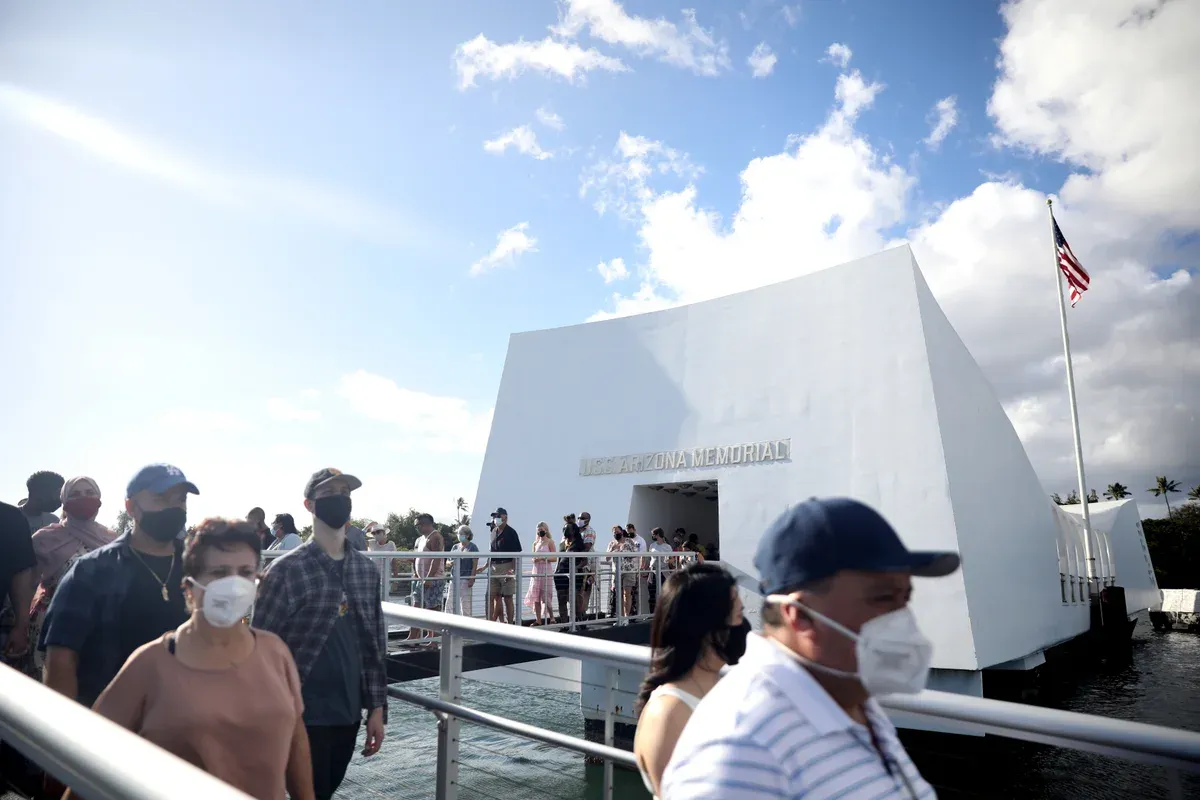
Visitors on the dock at the entrance of the USS Arizona Memorial. Photo: Gage Skidmore from Surprise, AZ, United States of America, CC BY-SA 2.0, via Wikimedia Commons
Quick answer The bag rule in one line
The Pearl Harbor bag policy refuses any bag, package or container that offers concealment and exceeds 1.25 by 2.25 by 5.5 inches, the size of a small wallet. Clutches and wallets at or under that size are allowed, and bags whose contents are readily visible, like clear stadium bags, are allowed. Every permitted bag is inspected and tagged as screened before you go further.
Key takeaways
- Bag storage costs $7 per bag and $10 for oversized bags and luggage, run by the Pacific Fleet Submarine Museum near the visitor center entrance. Details in the bag rule section.
- Bring a clear backpack or clear stadium-style bag if you want to carry more than a wallet, and expect it to be inspected.
- If you would rather not deal with security at all, a guided option like the Star of Honolulu Deluxe Coach Tour gets you from Waikiki to Pearl Harbor with hotel pickup.
- Compare operators, prices and what each ticket covers on Pearl Harbor tours from Honolulu, or read how the free reservations work in Pearl Harbor tickets.
The Bag Rule in Plain Words
The National Park Service publishes the rule on its safety page and enforces it with screening at the visitor center. The figures below come from those official sources.
What Is Allowed and What Is Refused
The core of the Pearl Harbor bag policy is concealment. Bags, packages or containers that offer concealment and exceed 1.25 by 2.25 by 5.5 inches are not allowed. That is the figure on the NPS safety page. The NPS FAQ page carries a slightly different figure, 1.5 by 2.25 by 5.5 inches, so the two official sources disagree by a quarter inch on the first dimension. The safe move is to plan for the smaller, stricter figure. Bags whose contents are readily visible are allowed, in the same way bags are handled at football games.
In practice this means a regular purse, tote or solid backpack fails the test once it is bigger than a small wallet. A clear see-through bag passes, because its contents are visible, but the NPS still says every permitted bag is inspected and tagged as screened at entry. A camera bag follows the same general rule: if it offers concealment and is bigger than a small wallet it is refused, while camera gear carried openly or in a clear bag is screened and admitted. The one stall of bag storage at the site can be used for visits to all Pearl Harbor Historic Sites, so you only pay once even on a full day. The table sums it up item by item.
| Item | Allowed | Note |
|---|---|---|
| Small purse or clutch | Yes, if within size | Clutches and wallets up to 1.25 x 2.25 x 5.5 inches are allowed and will be inspected and tagged |
| Solid backpack | No | Offers concealment and exceeds the wallet-size limit, put it in storage |
| Clear bag | Yes | Bags whose contents are readily visible are allowed, still inspected and tagged as screened |
| Camera bag | No, if it conceals | Concealment is the test, carry the camera openly or use a clear bag |
| Diaper bag | No | Diaper supplies can go in a clear sealable bag under a stroller seat |
| Medical bag | Yes, declared | Must be declared to security and is screened, allow extra time |
| Water bottle | Yes | Food and water are allowed if not concealed in a package, only water inside museums, theaters, Navy vessels and the memorial |
| Stroller | Not on boats or the memorial | Stays in the pre-boarding area at the Park Theater, bring a baby carrier instead |
Bag Storage: Where It Is and What It Costs
The Pacific Fleet Submarine Museum runs the bag storage facility near the visitor center entrance, and it charges a fee for all sizes, including luggage. Storage costs $7 per bag, and $10 for oversized bags and luggage. The facility sits on the right as you enter the memorial area, so you will walk past it on your way in. One storage stall can be used for visits to all Pearl Harbor Historic Sites, which matters if you are doing the Arizona first and the Missouri later, because you do not pay twice.
The $7 and $10 fees are separate from your admission. The USS Arizona Memorial reservation itself is free with a $1 Recreation.gov fee. Some tour listings name the same fee explicitly, so budget it either way. The Pearl Harbor, Dole and Polynesian Center Day Tour, for example, lists bag storage at $7 each among its exclusions, and the Best of Pearl Harbor Full-Day Tour lists $7 to $10 at the visitor center. The Salute to Pearl Harbor Tour names nearby lockers at $6 in one part of its listing and $7 in another, so check what your operator offers before you arrive.
If You Arrive with a Refused Bag
A refused bag has to be dealt with before you enter. Your options are the paid storage described above or returning the bag to your vehicle. The NPS asks that vehicles in the lot be locked and states it is not responsible for stolen items, so anything you leave in the car should be out of sight and the car locked.
Build extra time into your morning for the screening line, and more if you are carrying a medical bag that needs to be declared. The bag rule applies on a tour too, so check your operator's listing, as several name storage fees. The half-day Pearl Harbor tours from Waikiki are compared on the homepage.
Sources: NPS safety page, NPS FAQ, Battleship Missouri security page
ID and the Dress Code
Two questions trip people up: when you need photo ID, and what counts as appropriate dress. The answers differ between the free memorial site and Ford Island.
When Photo ID Is Needed and When It Is Not
Pearl Harbor National Memorial itself needs no ID and no NPS pass, because entry and the Arizona Memorial tickets are free once reserved. The ID rules attach to Ford Island. On the Ford Island shuttle to the Battleship Missouri or the Pearl Harbor Aviation Museum, guests may be asked for a government photo ID, and foreign visitors should carry a passport. The bag policy applies to everyone on that shuttle too, so the same wallet-size and clear-bag rules govern your ride across the bridge.
The NPS Ford Island Bus Tour to the USS Oklahoma and USS Utah memorials needs a government photo ID from the ticket buyer at check-in. That tour can also be cancelled at short notice for base security reasons, so do not build your whole day around it. Visitors without military ID use that bus. On any Ford Island day, including a guided one such as the Arizona and Battleship Missouri Tour at $156, carry your passport or license, because the shuttle may ask for it.
What to Wear
The NPS asks for appropriate dress because the site is a place of remembrance and the final resting place for many of the USS Arizona's crew. A shirt and shoes are the baseline. Beachwear belongs at the beach, not here, and the same standard applies elsewhere on Oahu, since Iolani Palace requires shirts and footwear, provides shoe coverings, and does not permit beachwear. If your day pairs Pearl Harbor with a city stop, dress for the stricter venue and you will be fine at both.
The NPS recommends comfortable footwear, a hat, sunglasses and reef-safe sunscreen, which suits the open walkways of the visitor center. Uniformed military visitors must wear Class B or better to reach the memorial. The Battleship Missouri asks for respectful attire and lists comfortable walking shoes, with sandals allowed, and lightweight clothing for the warm decks. Oahu daytime highs run from the mid-70s to mid-80s F year round, so light layers work at every site on Pearl Harbor tours from Honolulu.
Sources: NPS FAQ, Missouri directions, NPS Ford Island Bus Tour
10 Tips for Visiting Pearl Harbor
Practical tips for the day, from the bag rule to arriving early. Third-party video by Cruise Lifestyle. This site did not shoot it and has no relationship with the creator.
What to Bring and What to Leave
With the bag rule settled, the packing list is short. Here is what the official sources support.
The List
Each item below traces back to the NPS or the Historic Sites guidance, so you can pack with confidence and clear the screening line on the first pass.
- A small clutch or wallet within the 1.25 x 2.25 x 5.5 inch limit, since anything bigger that conceals is refused
- A clear backpack or clear sealable bags if you need to carry more, contents visible and ready for inspection
- Water, allowed if not concealed in a package, and only water is permitted inside the museums, theaters, Navy vessels and the memorial, with fountains throughout the park for refills
- Reef-safe sunscreen, a hat and sunglasses, the items the NPS itself recommends
- Comfortable footwear, with sandals permitted on the Missouri's decks
- A baby carrier instead of a stroller for the Arizona program, because strollers stay at the Park Theater pre-boarding area and do not board the Navy boats or the memorial
- Photo ID or a passport if your day includes Ford Island, since shuttle guests may be asked for a government photo ID
- Patience for screening, since every permitted bag is inspected and tagged, and declared medical bags need extra time
Children and Accessibility
Families manage fine within the rules. Diaper supplies travel in a clear sealable bag under the stroller seat, which satisfies the concealment test while keeping supplies at hand. Baby food jars are the exception to the glass container ban, and tempered glass water bottles are allowed too. Leave the stroller behind for the boat ride itself and carry the baby instead.
The Pearl Harbor National Memorial grounds are wheelchair accessible with mostly flat paths and no hills, though the park does not rent wheelchairs, so bring your own. Navy boats have wheelchair locks for the crossing. On Ford Island the picture varies. The Missouri offers complimentary wheelchairs at its main entrance, its shuttle has at least one wheelchair-lift vehicle, and the Aviation Museum is fully wheelchair accessible with free wheelchairs first come first served. The USS Bowfin submarine itself has steep ladders, tight spaces and low clearances and is not wheelchair accessible. If accessibility shapes your day, a coach option such as the Star of Honolulu Deluxe Coach Tour, rated 4.9 from 5,031 reviews at $59.23 for the 5-hour version, lists a lift vehicle on request with 24 hours notice, and the Pearl Harbor Visitor Center guide covers the layout in detail.
Sources: NPS FAQ, NPS safety page, Missouri accessibility
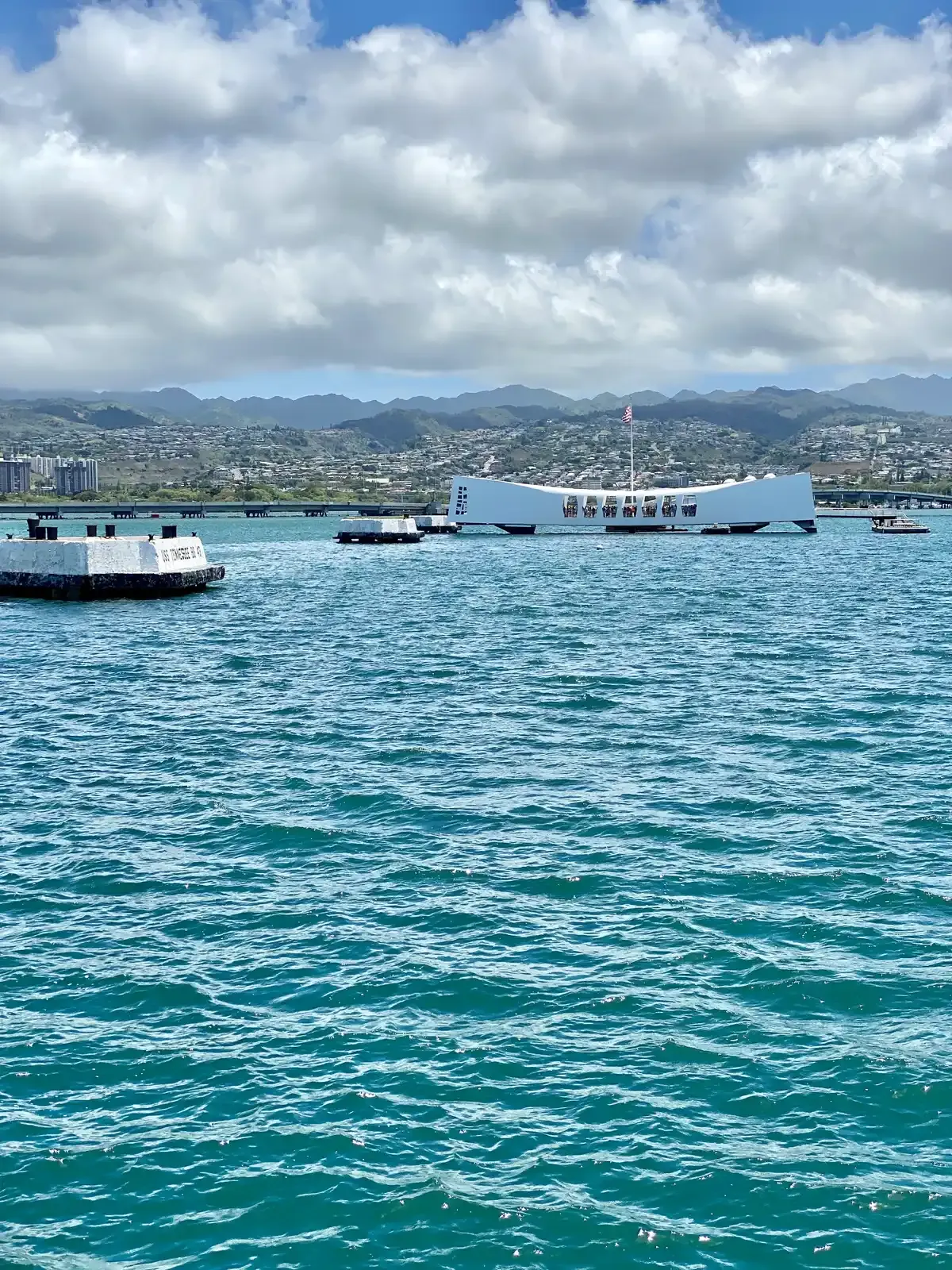
The USS Arizona Memorial seen across the harbor water from shore. Photo: w_lemay, CC BY-SA 2.0, via Wikimedia Commons
Bag Policy and Rules FAQ
Can I bring a purse into Pearl Harbor?
Yes, if it is a clutch or wallet at or under 1.25 by 2.25 by 5.5 inches, which is the size the NPS safety page allows. A larger purse offers concealment and is refused at screening. Every permitted bag is inspected and tagged as screened, and anything bigger goes into the paid storage by the entrance. See the full bag rule breakdown.
Are clear bags allowed at Pearl Harbor?
Yes. The NPS allows bags whose contents are readily visible, the same standard used at football games, so a clear stadium-style backpack is the practical way to carry jackets, snacks and water. The bag still gets inspected and tagged as screened at the entrance. Read more on the clear bag rule.
How much is bag storage at Pearl Harbor?
Storage costs $7 per bag and $10 for oversized bags and luggage. The Pacific Fleet Submarine Museum runs the facility near the visitor center entrance, on the right as you enter, and one stall can be used for visits to all Pearl Harbor Historic Sites, including luggage. For the wider cost picture, see Pearl Harbor tickets.
Do I need a passport at Pearl Harbor?
Not for Pearl Harbor National Memorial itself, which needs no ID because entry and Arizona tickets are free. You may need ID for Ford Island: guests on the shuttle to the Missouri or the Aviation Museum may be asked for a government photo ID, and foreign visitors should carry a passport. The NPS Ford Island Bus Tour also requires one from the ticket buyer at check-in. Details in the ID section.
Can I bring food and water into Pearl Harbor?
Food and water are allowed if they are not concealed in a package, so a clear bag or an open bottle works. Once you go inside the museums, the theaters, the Navy vessels or the memorial, only water is permitted. Water fountains throughout the park let you refill bottles. Alcohol, glass containers (baby food jars and tempered glass water bottles excepted), knives and multitools are all prohibited, as are bicycles, scooters, e-bikes and Segways.
Is there a dress code at Pearl Harbor?
The NPS asks for appropriate dress because the site is a place of remembrance and the final resting place for hundreds, so wear a shirt and shoes and leave beachwear at the hotel. Uniformed military visitors need Class B or better to reach the memorial, and the Missouri asks for respectful attire with comfortable walking shoes, sandals allowed. More in the dress code section.